Understanding the GraphQL Type System
Introduction
GraphQL is a modern solution for facilitating the communication between a front end and a data source. All of the details and capabilities of a GraphQL implementation are laid out in the GraphQL Schema. In order to write a functioning GraphQL schema, you must understand the GraphQL Type System.
In this article, you will learn about GraphQL types: the five built-in scalar types, Enums, the List and Non-Null wrapping types, Object types, and the abstract Interface and Union types that work alongside them. You will review examples for each type and learn how to use them to build a complete GraphQL schema.
Prerequisites
To get the most out of this tutorial, you should have:
- An understanding of the fundamental concepts of GraphQL, which are laid out in An Introduction to GraphQL.
- A GraphQL environment
Scalar Types
All the data in a GraphQL schema ultimately resolve to various scalar types, which represent primitive values. GraphQL responses can be represented as a tree, and the scalar types are the leaves at the ends of the tree. There can be many levels in a nested response, but the last level will always resolve to a scalar (or Enum) type. GraphQL comes with five built-in scalar types: Int, Float, String, Boolean, and ID.
Int
Int is a signed 32-bit non-fractional numerical value. It is a signed (positive or negative) integer that does not include decimals. The maximum value of a signed 32-bit integer is 2,147,483,647. This is one of the two built-in scalars used for numerical data.
Float
A Float is a signed double-precision fractional value. It is a signed (positive or negative) number that contains a decimal point, such as 1.2. This is the other built-in scalar used for numerical data.
String
A String is a UTF-8 character sequence. The String type is used for any textual data. This can also include data like very large numbers. Most custom scalars will be types of string data.
Boolean
A Boolean is a true or false value.
ID
An ID is a unique identifier. This value is always serialized as a string, even if the ID is numerical. An ID type might be commonly represented with a Universally Unique Identifier (UUID).
Custom Scalars
In addition to these built-in scalars, the scalar keyword can be used to define a custom scalar. You can use custom scalars to create types that have additional server-level validation, such as Date, Time, or Url.
The server will know how to handle interactions with this new type using the GraphQLScalarType.
Enum Type
The Enum type, also known as an Enumerator type, describes a set of possible values.
Using the Fantasy Game API theme from other tutorials in the series, you might make an enum for the game characters' Job and Species with all the values the system will accept for them. An Enum is defined with the enum keyword, like so:
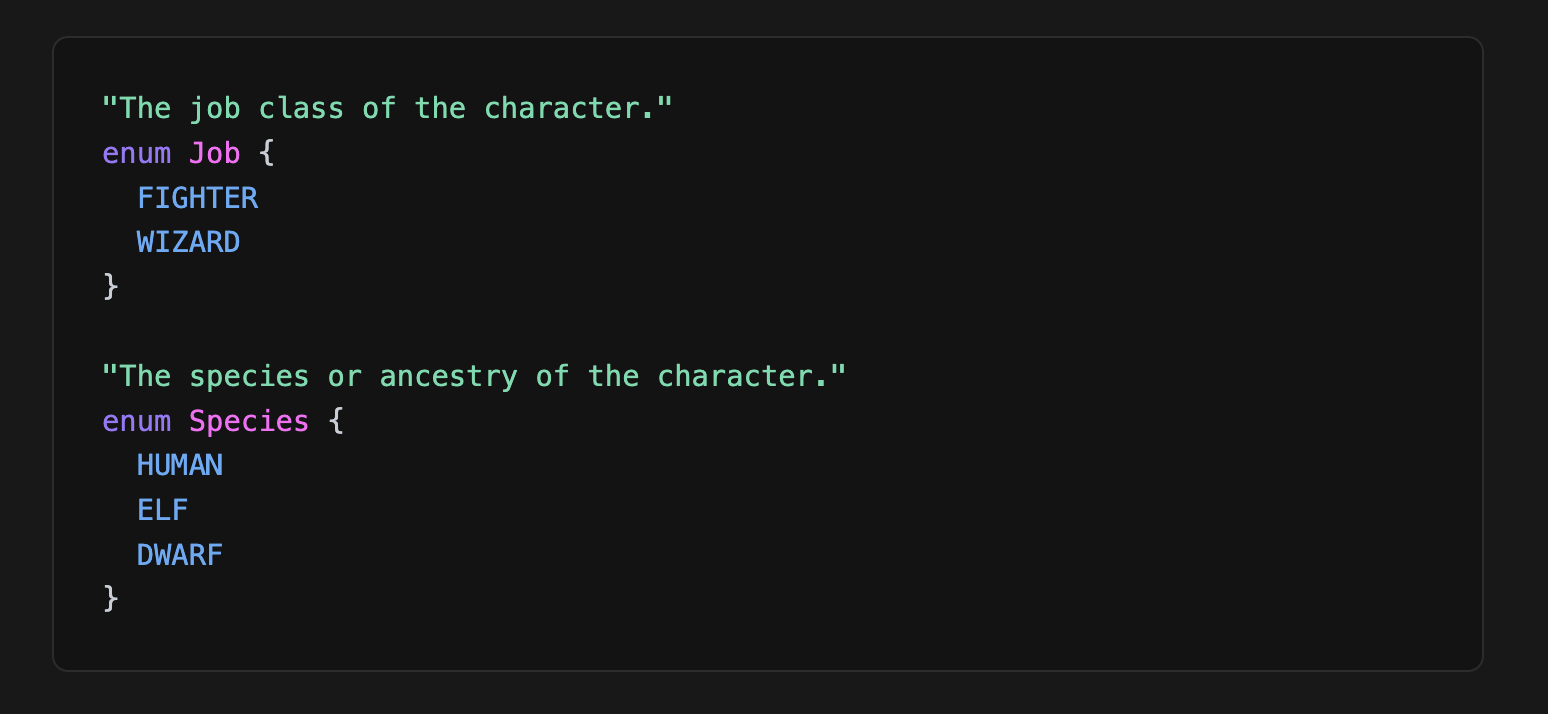
In this way, it is guaranteed that the Job of a character is FIGHTER or WIZARD and can never accidentally be "purple" or some other random string, which could be possible if you used a String type instead of making a custom Enum. Enums are written in all-caps by convention.
Enums can also be used as the accepted values in arguments. For example, you might make a Hand enum to denote whether a weapon is single-handed (like a short sword) or double-handed (like a heavy axe), and use that to determine whether one or two can be equipped:
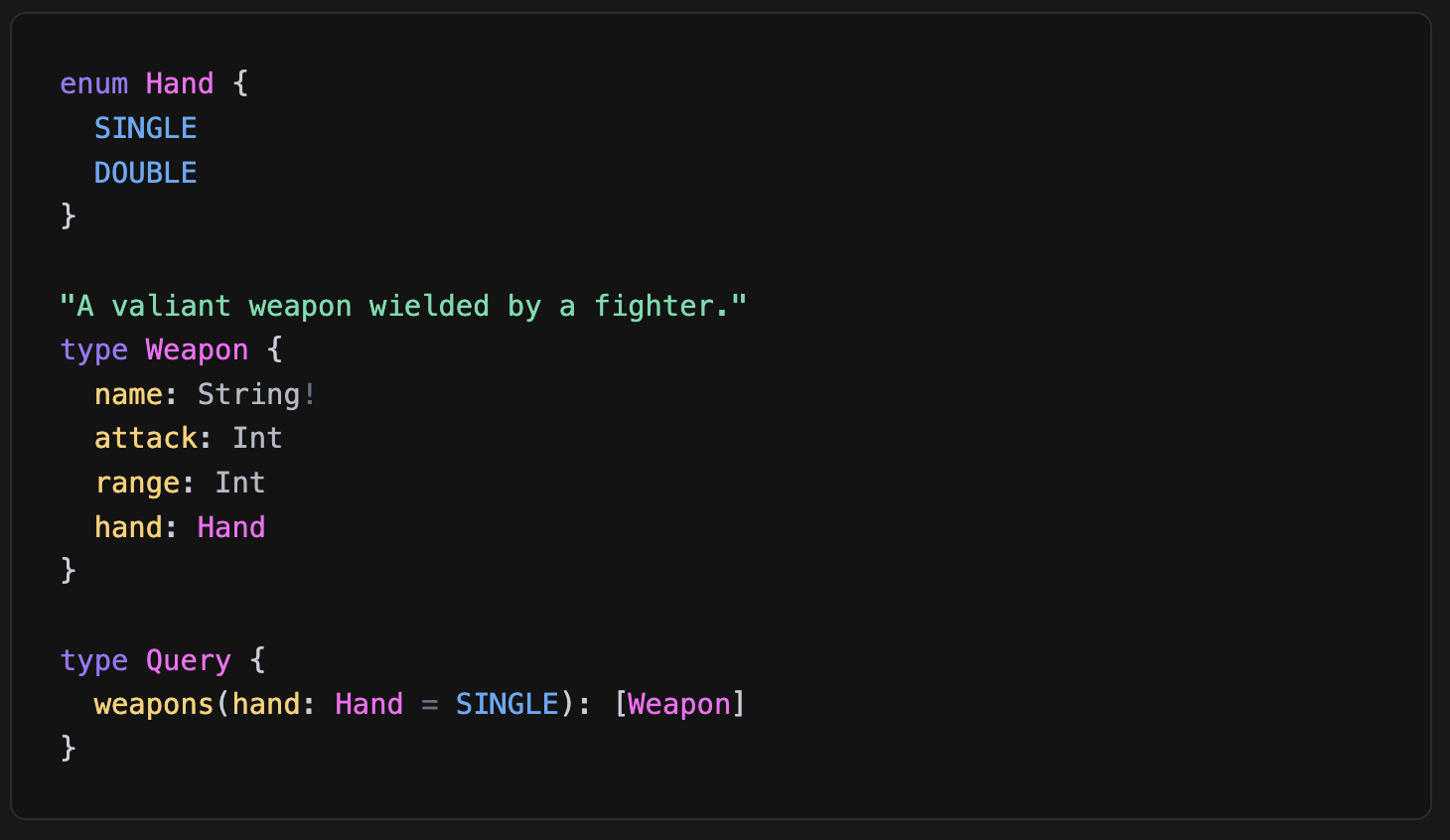
The Hand enum has been declared with SINGLE and DOUBLE as values, and the argument on the weapons field has a default value of SINGLE, meaning if no argument is passed then it will fall back to SINGLE.
Conclusion
In this tutorial, you learned about many of the types that define the GraphQL type system. The most fundamental types are the scalar types, which are the values that act as the leaves on the schema tree, and consist of Int, Float, String, Boolean, ID, and any custom scalar that a GraphQL implementation decides to create. Enums are lists of valid constant values that can be used when you need more control over a response than simply declaring it as a String, and are also leaves on the schema tree. List and Non-Null types are known as type modifiers, or wrapping types, and they can define other types as collections or required, respectively. Objects are the branches of the schema tree, and almost everything in a GraphQL schema is a type of Object, including the query, mutation, and subscription entrypoints. Interface and Union types are abstract types that can be helpful in defining Objects.
For further learning, you can practice creating and modifying a GraphQL schema by reading the How to Set Up a GraphQL API Server in Node.js tutorial to have a working GraphQL server environment.
I hope you enjoyed the article.
See you in the next post.
Have a great day!